Tuesday, March 22, 2011

Pumpkin Cookies


I know pumpkin cookies are out of season but they are a favorite in my house all year long.  Over the years I have tried different recipes but always go back to the original recipe I created.  Some recipes call for nuts, chocolate chips, and raisins.  However, my boys love the soft and spongy texture with the earthy flavor of pumpkin and its complimentary spices (ground cinnamon and nutmeg).   I frost these cookies with either a sweet tangy cream cheese frosting (can is ok),  or a can of your favorite vanilla frosting.  To give it a rustic homemade look I also grate fresh nutmeg on top of the frosted cookies. 


Ingredients

  • 1 cup (2 sticks) unsalted butter, softened
  • 1 cup white sugar
  • 1 cup light brown sugar
  • 2 large eggs
  • 1 teaspoon vanilla extract
  • 1 cup canned pumpkin puree
  • 3 cups all-purpose flour
  • 2 teaspoons baking soda
  • 1/2 teaspoon salt
  • 1 teaspoon ground cinnamon
  • 1/4 teaspoon ground nutmeg
Directions
Heat the oven to 350 degrees F. Spray cookie sheets with nonstick spray or line them with parchment paper.

Using a mixer, beat the butter until smooth. Beat in the white and brown sugars, a little at a time, until the mixture is light and fluffy. Beat in the eggs 1 at a time, then mix in the vanilla and pumpkin puree. In a large bowl, whisk together the flour, baking soda, salt, cinnamon, ginger, nutmeg, and cloves. Slowly beat the flour mixture into the batter in thirds. Scoop the cookie dough by heaping tablespoons onto the prepared cookie sheets and bake for 15 to 20 minutes, or until the cookies are browned around the edges. Remove the cookie sheets from the oven and let them rest for 2 minutes. Take the cookies off with a spatula and cool them on wire racks completely before frosting. 


Sunday, March 13, 2011

A new trend?


Working as a French Pastry Chef I am beginnig to see the classics coming back.  One of these happens to be the Napolean. 

This is a classic French dessert recipe that never fails to impress! The French name for a Napoleon dessert is Mille Feuille, meaning "a thousand sheets" acurately describing this layered crispy puff pastry lined with a contrasting butter cream filling… absolutely delicious and oh so satisfying! You can prepare this dessert individually or as one large rectangular pastry.

Preparation Time: about 30 minutes
Cooking Time: about 20 minutes
Refrigeration Time: at least 30 minutes

Ingredients:

1 lb. Pre-made Puff Pastry (refrigerated or frozen - both are good!)
4 cups Whole Milk
2/3 cup Granulated Sugar
1/3 cup Flour
7 oz. Butter (room temperature)
2 tbsp. Cornstarch
2 Vanilla Beans
10 Egg Yolks
Additional Flour to roll out pastry crust
Additional Butter for baking sheet (or use parchment paper as a lining)
Powdered Sugar to decorate

How to Make It:

Preheat oven to 400°F
1. On a lightly floured surface, roll out pastry into a large rectangle that you will be able to cut into three even parts (once cooked, not now!). Transfer rolled out pastry onto a baking sheet (lightly buttered or else lined with parchment paper). Prick top of pastry with a fork. Cover pastry with a layer of parchment paper and place another baking sheet, of the same size, on top, to keep pastry flat. If you don't have another baking sheet, just pour rice or any dried bean over the top. Put in the refrigerator for at least 30 minutes.
2. Remove pastry from the refrigerator and bake (with either the additional baking sheet on top, or with the rice/beans on top) for ten minutes. Take out of oven, remove baking sheet (or rice/beans) and remove top layer of parchment paper. Put back in oven for another 10 to 15 minutes or until lightly browned. Remove from oven and let cool off entirely before spreading on cream filling.
3. As your pastry is baking, you can prepare the cream filling. In a large saucepan combine the yolks and sugar and stir well. Then stir in flour, and cornstarch.
4. Cut vanilla beans in half lengthwise, and scrape out the seeds into the mixture and stir well.
5. Slowly stir in the milk until homogenous. Put the cream filling on the stove (light heat) and very gently bring to a simmer -- when you see small bubbles, take it off the heat and refrigerate.
6. In a large mixing bowl, beat the butter so that it rises. Gently mix in the rest of the cream filling.
7. Once the pastry has cooled, cut it carefully (serrated knife works best) into three even parts. Using a spoon and a spatula spread a thick layer of cream filling on two parts of pastry crust. Stack these two layers and cover with the third (top) pastry piece. Sprinkle top with powdered sugar. Refrigerate until serving.
Voilà!

Take a look at the ideas below if you are looking for more ways to make napoleon dessert recipes! There's no shortage!

Variations for Napoleon Dessert Recipes


Chocolate Napoleon: Follow the traditional recipe above, just add chocolate to the cream filling! Use 8 oz. of unsweetened baking chocolate. Cut into small pieces and stir in as you are warming up the cream filling. Just make sure to stir enough so that the texture of the cream is completely even. You can still use the vanilla if you want, or you can leave it out.

Orange-Cream Napoleon: Follow the traditional recipe, just substitute the vanilla with 1 to 2 tbsp. of grated orange rind… depending on how strong you want it to be.

Almond Napoleon: Follow the traditional recipe, just add 3 tbsp. of ground almond powder right before adding the flour and cornstarch. Use 1 vanilla bean instead of two. Sprinkle the top of each layer with a thin coat of grilled almond slices.

Orange Blossom Napoleon: Follow the traditional recipe, just add 2 tbsp. of orange blossom water right before adding the flour and cornstarch. Use one vanilla bean instead of two.

Berry Napoleon: Follow the traditional recipe, adding a thin layer of berries on top of the cream filling. You can use raspberries, blueberries, sliced strawberries, blackberries… or anything that suits your fancy! Decorate the top with powdered sugar and with berries.


Serving Ideas:

As stated above, napoleon dessert recipes can be served as one large pastry or can be made in individual portions. It's really up to you!

Sunday, March 6, 2011

Keeping with the flour tradition, Graham flour?

So, the next time you think a recipe is calling for graham cracker crumbs (like me) think again.  It really is a flour!

Graham flour is a form of whole wheat flour. It is named for Sylvester Graham, a forerunner of the health food movement. Graham developed this form of flour in the 1830s in hopes of diverting people away from the less healthy refined white flour. His Graham hotels promoted vegetarian meals and unseasoned foods, being of the belief that condiments would encourage the imbibing of alcohol.

To make graham flour, the endosperm of winter wheat is finely ground. The bran and germ layers are returned and mixed in, resulting in a coarse, brown flour with a nutty and slightly sweet flavor. Today, some commercial granaries remove much of the wheat germ to prolong the shelf life of the flour. The germ contains oil that accelerates rancidity. Graham flour is unrefined and unbleached.

Although the terms graham flour and whole wheat flour are often used interchangeably, there is a difference. Graham flour is a slightly coarser grind than whole wheat flour.

Tuesday, March 1, 2011

Pastry flour, what is it?


Pastry flour, sometimes also called cookie flour, is a type of soft wheat flour. Soft flours are those flours that have reduced gluten, a special type of protein, than the average all-purpose flour or bread flour. They’re recommended for pastry because they help cut down on how glutinous flour will get when added to pastry recipes, and they’re usually superior in the end result to all purpose flour for pastries, helping to produce a crunchy and delicate, rather than an overworked or tough crust.

The softest flour is normally cake flour, which may also be treated with bleaching agents, in addition to being finely milled. It has the lowest gluten amount and is ideal when you’re making most cakes. Generally the softer and less glutinous the flour, the more tender the resultant cake. Cake flour has about 5-8% gluten or protein.

It can be a challenge to find pastry flour. Even well-stocked supermarkets seldom carry more varieties than cake flour, all-purpose flour (9% to 12% protein), and bread flour. If you can't find pastry flour, you can mix you own by combining cake flour and all-purpose flour in a ratio somewhere between two parts cake flour to one part all-purpose and one part cake flour to one part all-purpose.

Monday, February 28, 2011

Gluten-Free is not a fad

It seems that in the healthy baking arena demand is growing for gluten-free products.  Most consumers who buy gluten-free foods do so because they need them for restricted diets, not because they desire them for nutritional benefits. These consumers suffer from celiac disease, a chronic condition in which proteins derived from gluten in ingredients such as wheat, rye and barley, damage the small intestine.
The disease affects 1 out of every 133 people, or just less than 1% of the population, according to the National Foundation for Celiac Awareness. In addition, another 40 million Americans are thought to have non-celiac gluten intolerance.

As the number of people diagnosed with celiac disease has increased, so has demand for gluten-free products. Sales of labeled gluten-free bread and bakery foods in natural foods retail outlets increased 60% from $17 million for the 52 weeks ending June 2008 to an estimated $27.2 million for the like period ending June 2010, according to Mintel International Group, Chicago.

The growth of gluten-free bakery sales is not a fad, unlike the no-carb craze that fizzled. A core segment of consumers needs these products, and the upward trend is helping to raise the bar on product quality and variety for consumers with celiac disease and other gluten sensitivities.

I have done reasearch on gluten-free recipes and below you will find a great vanilla cake or cupcake recipe.
1 cup (2 sticks) butter, margarine or Spectrum Organic Shortening
2 cups granulated sugar
4 large eggs, room temperature
2 teaspoons pure vanilla extract
3½ cups gluten-free All-Purpose Flour Blend+ extra for dusting
1 tablespoon + 1 teaspoon baking powder
1 teaspoon baking soda
1 teaspoon xanthan gum
1 teaspoon salt
1½ cups cow’s milk or rice milk, hot
1. Preheat oven to 350 degrees. Grease two 8- or 9-inch round cake pans and dust with gluten-free flour.
2. In the bowl of an electric mixer, beat margarine and sugar at high speed until light and fluffy, approximately 5 minutes. Lower speed to medium and add eggs, one at a time. Add vanilla and beat until fluffy again, scraping down bowl.
3. In a separate bowl or on a piece of waxed paper, sift together flour blend, baking powder, baking soda, xanthan gum and salt.
4. Add half the dry mixture to the sugar mixture and beat at low speed until combined. Add half the milk and blend. Then add remaining dry ingredients and milk. Mix on medium-low speed until smooth, approximately 2 minutes.
5. Divide batter equally between the two prepared pans. Bake in preheated oven for approximately 35 minutes or until done. Cool the cake for 20 minutes in pans. Then turn cake onto wire racks and cool completely before frosting.
Cake serves 16. Each serving contains 324 calories, 13g total fat, 5g saturated fat, 0g trans fat, 53mg cholesterol, 49g carbohydrate, 370mg sodium, 0g fiber, 3g protein.
TIP This cake can be made egg free. Replace 4 large eggs with 6 tablespoons unsweetened applesauce mixed with 2 teaspoons baking powder + 4 tablespoons warm water mixed with 1 tablespoon gluten-free egg replacer.

Tuesday, February 22, 2011

The French Macaroon

Although predominantly a French confection, there has been much debate about its origins. Larousse Gastronomique cites the macaron as being created in 791 in a convent near Cormery. Some have traced its French debut back to the arrival of Catherine de' Medici's Italian pastry chefs whom she brought with her in 1533 upon marrying Henry II of France.[6]
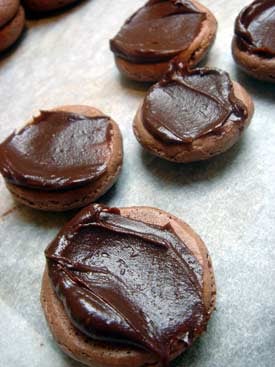
In the 1830s, macarons were served two-by-two with the addition of jams, liqueurs, and spices. The macaron as it is known today was called the "Gerbet" or the "Paris macaron" and is the creation of Pierre Desfontaines of the French pâtisserie Ladurée,[7] composed of two almond meringue discs filled with a layer of buttercream, jam, or ganache filling.
Here is an Awesomely ddelicious recipe.
 Macaron Batter
spreadfillmacaronsparis.jpg1 cup  powdered sugar
½ cup powdered almonds  (sliced almonds, pulverized)
3 tablespoons unsweetened Dutch-process cocoa powder
2 large egg whites, at room temperature
5 tablespoons granulated sugar
Chocolate Filling½ cup heavy cream
2 teaspoons light
corn syrup
4 ounces  bittersweet or semisweet chocolate, finely chopped
1 tablespoon  butter, cut into small pieces
Preheat oven to 350º F.
Line two baking sheets with parchment paper and have a pastry bag with a plain tip (about 1/2-inch) ready.
Grind together the powdered sugar with the almond powder and cocoa so there are no lumps; use a blender or food processor since almond meal that you buy isn’t quite fine enough.
In the bowl of a standing electric mixer, beat the egg whites until they begin to rise and hold their shape. While whipping, beat in the granulated sugar until very stiff and firm, about 2 minutes.
Carefully fold the dry ingredients, in two batches, into the beaten egg whites with a flexible rubber spatula. When the mixture is just smooth and there are no streaks of egg white, stop folding and scrape the batter into the pastry bag (standing the bag in a tall glass helps if you’re alone).
Pipe the batter on the parchment-lined baking sheets in 1-inch circles (about 1 tablespoon each of batter), evenly spaced one-inch apart.
Rap the baking sheet a few times firmly on the counter top to flatten the macarons, then bake them for 15-18 minutes. Let cool completely then remove from baking sheet.
To make the chocolate filling:
Heat the cream in a small saucepan with the corn syrup. When the cream just begins to boil at the edges, remove from heat and add the chopped chocolate. Let sit one minute, then stir until smooth. Stir in the pieces of butter. Let cool completely before using.
Assembly
Spread a bit of batter on the inside of the macarons then sandwich them together. (You can pipe the filling it, but I prefer to spread it by hand; it’s more fun, I think.)
I also tend to overfill them so you may or may not use all the filling.
Let them stand at least one day before serving, to meld the flavors.
Store in an airtight container for up to 5 days, or freeze. If you freeze them, defrost them in the unopened container, to avoid condensation which will make the macarons soggy.

Monday, February 21, 2011

The Whoopie Pie

I've been doing research about the latest baking trends and today I found an article about whoopie pies.  Everyone knows what a pie is but do you know what a whoopie pie is?  I'll tell you.  A whoopie pie is like a sandwich, but made with two soft cookies with a fluffy white filling. Traditional whoopies pies are made with vegetable shortening, not butter. The original and most commonly made whoopie pie is chocolate.

The recipe for whoopie pies has its origins with the Amish, and in Lancaster county, Pennsylvania, it is not uncommon to find roadside farm stands offering these desserts. Amish cooking is about old recipes that have fed families for generations, with no trendy or cross-cultural fusions or mixtures. These cake-like whoopie pies were considered a special treat because they were originally made from leftover batter. According to Amish legend, when children would find these treats in their lunch bags, they would shout "Whoopie!"
Main's earliest claim is from the Labadie's Bakery in Lewiston, Massachusetts. They first started selling Whoopie Pies in 1925 with the opening of their bakery. The Labadie's Bakery remains in the same location today.
The Berwick Cake Company of Roxbury, Massachusetts, also manufactured “Whoopee pies” since at least 1931. Some think that Berwick’s pies actually date to 1927. Berwick closed its Roxbury plant in 1977.
The question of how the Amish dessert got to be so popular in New England probably is addressed in a 1930s cookbook called Yummy Book by the Durkee Mower Company, the manufacturer of Marshmallow Fluff. In this New England cookbook, a recipe for Amish Whoopie Pie was featured using Marshmallow Fluff in the filling.
According to the Marshmallow Fluff website:
The origins of Marshmallow Fluff actually go back to 1917. Before WWI, a Sommerville MA man named Archibald Query had been making it in his kitchen and selling it door to door, but wartime shortages had forced him to close down. By the time the war was over, Mr Query had other work and was uninterested in restarting his business, but he was willing to sell the formula. Durkee and Mower pooled their saving and bought it for five hundred dollars. Having just returned from France, they punningly renamed their product "Toot Sweet Marshmallow Fluff" but "Toot Sweet" didn't stay on the label for long. The situation of "no customers, but plenty of prospects" didn't last long either.
An early receipt still in the company's scrap books records the sale in April, 1920 of three one-gallon cans to a vacation lodge in New Hampshire. The price at the time was $1.00 a gallon! The door to door trade gained a reputation among local housewives that eventually placed Fluff onto local grocers shelves. Retail trade spread from there to the point where in 1927 they were advertising prominently in Boston newspapers.
Durkee-Mower became a pioneer in radio advertising when in 1930 they began to sponsor the weekly "Flufferettes" radio show on the Yankee radio network, which included twenty-one stations broadcasting to all of New England. The fifteen minute show, aired on Sunday evenings just before Jack Benny, included live music and comedy skits, and served as a steppingstone to national recognition for a number of talented performers. The show continued through the late forties.

Each episode ended with a narrator reporting that Boswell had disappeared to continue work on his mysterious book, which was assumed to be a historical text of monumental importance. On the last episode the Book-of-the-Moment was revealed. It was a collection of recipes for cakes, pies, candies, frostings and other confections that could be made with Marshmallow Fluff, appropriately entitled the Yummy Book. The book has been updated many times since then, and the most recent version is thirty-two pages long.

Gob History:
It seems that only in western Pennsylvania, mainly the Johnstown area, they are know as "gobs." The bakers at the now closed Harris & Boyar Bakery in Morrellville, PA, claimed to have invented the treat sometime in the 1920s. Probably they adapted what was already a regional favorite inspired by the cream-filled whoopie pies of Pennsylvania Dutch country, in the eastern part of the state.
According to an article in the Johnstown Tribune-Democrat newspaper, Johnstown’s Gob - A mealtime tradition, March 12, 2009:
Susan Kalcik, a folklorist and archivist with the Southwestern Pennsylvania Heritage Preservation Commission in Johnstown, said her research shows that the Gob’s origin can be traced back to medieval Germany. "They were making a cake-like pastry with a filling. It probably was brought to America by various German groups like the Amish or German Brethren."
But Kalcik said the Gob is not a Johnstown invention. The Amish in Lancaster make them and she’s seen them as far south as Virginia. "They don’t call them Gobs, they’re called Whoopee Pies, " she said. "I’ve also found Whoopee Pies in New England and as far away as Hawaii."
Kalcik believes that the Gob became popular because it was easy to carry in a lunch bucket. "Men went into the coal mines or steel mills and the little cake with the icing on the inside instead of on the outside served their purpose," she said. "I’m convinced that the name Gob is related to the coal mines. Lumps of coal refuse were called gob piles. These working people adapted the name to the dessert."
But technically, not just anyone can use the name "Gob" for the familiar icing filled treats. The name-along with all the rights to market "Gobs"- belongs to Tim Cost, owner of Dutch Maid Bakery. Cost, who bought the rights from Harris & Boyar Bakery in Morrellville, said he’s always had a passion for the cake.
 
At the Hershey Farm and Inn in Strasburg, PA, an annual Whoopie Festival is held featuring a whoopie pie eating contest and the coronation of the Whoopie Pie Queen.
In 2011, The Maine State Legislature considered making the Whoopie Pie the official state's dessert.

Now you know a little about whoopie pies!